The Story Behind this Blog

Being from the South, Silver is a very big part of my life. It doesn't have anything to do with wealth. Although those with more money - old money, tend to have more of it. New money tend not to spend their money on Silver. They do not have the appreciation for the warmth of the metal, the beauty of the patina, the story it tells of the generations past who have used it. A true southern girl comes of age when she chooses her silver pattern, long before she chooses her mate. If she is smart, she chooses that of her mother, grandmother, or favorite great aunt who in their benevolence will pass their silver on to her. It is the pieces in those sets, the pieces on our tables, along with the pieces we find in the corners of the displays in antique stores that prompted me to start this blog. They are beautiful, they are odd, but what are they, and what in the hell do you do with them?

Wednesday, January 27, 2010

Fried Egg Server

These pieces are more rare, but when you find one generally they are ornate and lovely pieces. Obviously, the large flat spatula part is part slipping under the fried egg to serve it onto the plate.

(Shown in Lily by Whiting 8 1/4 inches)


(Shown in Chantilly by Gorham 8 3/4 inches)

Click to Enlarge


Tuesday, January 26, 2010

Jelly Knife

There are several pieces dedicated to handling the Jelly condiment the Jelly Knife is designed to spread jelly on toast and biscuits.

(Jelly Knife shown in Oval Twist by Whiting)


(Jelly Knife shown in Canterbury by Towle)


(Jelly Knife shown in Louis XV by Whiting)


Monday, January 25, 2010

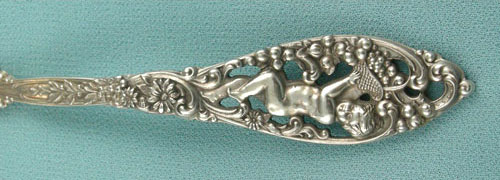
Labors of Cupid by Dominick and Haff

This pattern was first patented in 1900, discontinued, then reissued in 2000 by Reed & Barton. The Dominick and Haff pattern exhibits wonderful multi-dimensional scenes of cupid performing various labors and having a different attitude on each piece. As best I can tell the Reed & Barton pattern is the same as the original pattern. Some catalogs refer to this pattern as "1900".


(Large Chocolate Spoon 4 1/4 inches)

(3 Tine Salad Fork 7 inches)


(Oyster Fork 5 1/2 inches)


Saturday, January 23, 2010

Tea Caddy Spoon

A Tea Caddy Spoon was designed to get dip tea leaves from a box of tea (the "caddy"). Most of the bowls are round and may have a shell or scallop design. Rarely you will find Tea Caddy Spoons with piercings. They are designed to dip the annoying loose tea leaves from one's cup of tea.


(Shown in Vine by Tiffany)


(Olympian by Tiffany 4 3/8 inches)

Click to Enlarge

Friday, January 22, 2010

Almond Scoop

The Almond Scoop is a very small piece, some only 4 5/8 inches in length, small enough to fit in the palm of your hand. Most patterns have a wide circular bowl with ornate piercings. A truly beautiful piece. Used to scoop and serve almonds.


(Shown in Bacchante by Watson 6 inches)


(Shown in Flora by Shiebler 6 inches)


(Shown in Olympia by Watson 6 inches)


(Shown in Lily by Watson 4 5/8 inches)


Thursday, January 21, 2010

Pastry Server

The Pastry Server was used to move a piece of pastry to your plate. Then you would use a small Pastry Fork to eat the pastry. (In the event a pastry fork is not available, a salad fork will do nicely.)


(Pastry Fork shown in Buttercup by Gorham 5 3/4 inches)


(Pastry Fork shown in Georgian by Towle 5 3/4 inches)


Wednesday, January 20, 2010

Lemon Fork

Here we have a Lemon Fork well designed for piercing the thick rind of lemons. The splayed sharp tines assist in serving lemons. The number of tines varies from two to three. The helpful hostess can provide these with cocktails, seafood, or tea.


(Shown in Repousse by Kirk 4 1/2 inches)


(Shown in Valinciennes by Manchester 4 3/4 inches)


Monday, January 18, 2010

Olympian by Tiffany

The Olympian pattern designed by Tiffany is an incredibly unique work of silverware. Dr. Hood describes it best.

HISTORY OF OLYMPIAN PATTERN "Tiffany Silver Flatware 1845-1905 When Dining Was an Art"

“The style is Academic Beaux-Arts. The patent application credits Edward C. Moore, but there is good reason to believe F. Antoine Heller also contributed. The pattern was first introduced at the Expositiion Universelle, Paris, 1878. Olympian is a multi-motif pattern with seventeen (17) different handle decorations depicting subjects and stories from classical mythology. The motif varies with whether a piece has a flat or hollow handle.

Each design is elaborate, and though sharply carved, can be seen to best advantage when the background is oxidized, as are all pieces offered in this listing. On the obverse of each piece, the design covers the entire handle and has an unusual horizontal orientation.

Although the concept of seventeen (17) different handle designs in one flatware service was original, the idea of depicting a finely detailed scene horizontally over the entire flatware handle just as if it were a frieze was not.”


There are lovely pieces within the pattern.

(Kidney shaped conch spoon)


(Gravy Ladle)


(Cheese Scoop)


Saturday, January 16, 2010

Poultry Shears

Instead of having the servants cut the poultry in the kitchen prior to bringing it into the dining room to serve your guests, sterling silver Poultry Shears allowed hostesses to have their guests served their poultry warm at the table with style. These shears were used to quickly cut up the poultry into serving size pieces.

(Shown in Rose Pattern by S. Kirk & Son  10 1/8)

Click to Enlarge


(Shown in Repousse by Kirk & Sons 10 1/8  inches)


Click to Enlarge

Friday, January 15, 2010

Salad Serving Pieces

Once again the Victorians always happy to have another piece of sterling. The Lettuce Fork (approx 7 1/2 inches) was designed as a piece of flatware to go with a 5 piece place setting, used to eat a lettuce salad (a new favorite of the time). Although you can find old pieces in today's patterns, I could not find a pattern that still made them.


(Lettuce Fork shown in Monticello by Lunt)


A more standard salad serving piece is the Salad Serving Set consisting of a large fork and spoon. These are still found in most patterns. Although the pieces in the antique patterns tend to be more ornate.


(Salad Serving Set in Etruscan by Gorham)

Click to Enlarge