The Story Behind this Blog

Being from the South, Silver is a very big part of my life. It doesn't have anything to do with wealth. Although those with more money - old money, tend to have more of it. New money tend not to spend their money on Silver. They do not have the appreciation for the warmth of the metal, the beauty of the patina, the story it tells of the generations past who have used it. A true southern girl comes of age when she chooses her silver pattern, long before she chooses her mate. If she is smart, she chooses that of her mother, grandmother, or favorite great aunt who in their benevolence will pass their silver on to her. It is the pieces in those sets, the pieces on our tables, along with the pieces we find in the corners of the displays in antique stores that prompted me to start this blog. They are beautiful, they are odd, but what are they, and what in the hell do you do with them?

Wednesday, February 3, 2010

Pastry Tongs

Pastry Tongs are often confused with asparagus tongs. However, if you pay attention, you will notice that most asparagus tongs are much wider than pastry tongs. Also, many of the pastry tongs I have seen, have different shaped prongs, usually one is flat and one is fork-like shaped. They are easy to confuse. You do not find as many pastry tongs around as you do asparagus tongs.

(Shown in Cloeta by International 6 1/4 inches)


(Shown in Imperial Chrysanthemum by Gorham 6 1/2 inches)

Tuesday, February 2, 2010

Individual Pie Fork

The Victorians loved their pies, both meat and fruit filled, therefore the Pie Fork was an important piece of the place setting. The distinguishing feature of the fork is the wider left cutting tine. You can find Pie Forks in two sizes, large and small. Sometimes the smaller ones are referred to as "Pickle Forks" in certain patterns. The larger forks range in size from 7 to 7 1/2 inches (approximately) and the smaller ones between 5 3/4 and 6 1/2 inches (approximately).


(Small Pie Fork shown in Persian by Tiffany 6 3/8 inches)


(Small Pie Fork shown in Renaissance by Dominick and Haff 6 inches)


(Small Pie Fork shown in Watteau by Durgin 5 5/8 inches)


(Small Pie Fork shown in Tulip by Fessenden 5 3/4 inches)


Monday, February 1, 2010

The St. Dunstan (Chased) by Gorham

From the August 1, 1923 Gorham Catalog, this pattern is described as, "As its name implies, the St. Dunstan is a pattern which, by its massive strength and virile outlines, recalls the handiwork of the silversmiths of olden times. In addition to these noble qualities, however, it is characterized by a refinement and delicacy of detail and finish which are only rendered possible by the ingenious appliances at the service of the modern silversmith."

The pattern was issued in 1917. The only source I could find said it was discontinued in 1991.

(Place Fork 7 3/8 inches)

P0000031444S1552T2.jpg (600×92)


(Orange Spoon 5 3/4)

P0000031444S1510T2.jpg (600×147)

(Bon Bon Spoon 4 7/8 inches)

P0000031444S1523T2.jpg (600×257)

(Lemon Fork 5 5/8 inches)

P0000031444S1493T2.jpg (600×159)

(2 Piece Salad Set 8 3/4 inches)

P0000031444S1555T2.jpg (600×354)


Saturday, January 30, 2010

Gravy Serving Spoon

These are lovely and extremely expensive pieces. Unlike ladles, Gravy Serving Spoons are used to serve gravy, sometimes referred to as "Stuffing Spoons", although true Stuffing spoons are much longer.

(Shown in Oval Twist by Whiting)


Solid Gravy Serving Spoon in the Oval Twist (sterling, 1880) pattern by Whiting Divisn-Silvr

(Shown in Buttercup by Gorham)

Solid Gravy Serving Spoon in the Buttercup(str,lion/anchor/g,1899,nomono) pattern by Gorham Silver

Friday, January 29, 2010

Long Handled Lemonade Spoon

Given it's length (14 3/8 inches), this utensil would have to be designed to stir the lemonade in the pitcher.

(Shown in Louis XV by Whiting 14 3/8 inches)


Long Handled Lemonade Spoon in the Louis Xv (sterling, 1891, No Monograms) pattern by Whiting Divisn-Silvr

Thursday, January 28, 2010

Solid Spinach Serving Fork

This Spinach Serving Fork speaks for itself. The long tongs would lend themselves well to separate and left the spinach. The piercings above the tines add to the attractiveness. They were only made in a few patterns.

(Shown in Canterbury by Towle)

Solid Spinach Serving Fork in the Canterbury (sterling,1893,no Monograms) pattern by Towle

Wednesday, January 27, 2010

Fried Egg Server

These pieces are more rare, but when you find one generally they are ornate and lovely pieces. Obviously, the large flat spatula part is part slipping under the fried egg to serve it onto the plate.

(Shown in Lily by Whiting 8 1/4 inches)


(Shown in Chantilly by Gorham 8 3/4 inches)

Click to Enlarge


Tuesday, January 26, 2010

Jelly Knife

There are several pieces dedicated to handling the Jelly condiment the Jelly Knife is designed to spread jelly on toast and biscuits.

(Jelly Knife shown in Oval Twist by Whiting)


(Jelly Knife shown in Canterbury by Towle)


(Jelly Knife shown in Louis XV by Whiting)


Monday, January 25, 2010

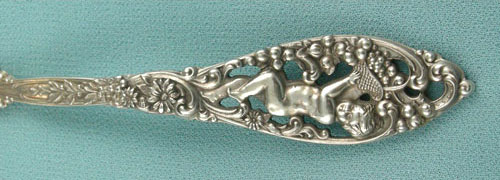
Labors of Cupid by Dominick and Haff

This pattern was first patented in 1900, discontinued, then reissued in 2000 by Reed & Barton. The Dominick and Haff pattern exhibits wonderful multi-dimensional scenes of cupid performing various labors and having a different attitude on each piece. As best I can tell the Reed & Barton pattern is the same as the original pattern. Some catalogs refer to this pattern as "1900".


(Large Chocolate Spoon 4 1/4 inches)

(3 Tine Salad Fork 7 inches)


(Oyster Fork 5 1/2 inches)


Saturday, January 23, 2010

Tea Caddy Spoon

A Tea Caddy Spoon was designed to get dip tea leaves from a box of tea (the "caddy"). Most of the bowls are round and may have a shell or scallop design. Rarely you will find Tea Caddy Spoons with piercings. They are designed to dip the annoying loose tea leaves from one's cup of tea.


(Shown in Vine by Tiffany)


(Olympian by Tiffany 4 3/8 inches)

Click to Enlarge