The Story Behind this Blog

Being from the South, Silver is a very big part of my life. It doesn't have anything to do with wealth. Although those with more money - old money, tend to have more of it. New money tend not to spend their money on Silver. They do not have the appreciation for the warmth of the metal, the beauty of the patina, the story it tells of the generations past who have used it. A true southern girl comes of age when she chooses her silver pattern, long before she chooses her mate. If she is smart, she chooses that of her mother, grandmother, or favorite great aunt who in their benevolence will pass their silver on to her. It is the pieces in those sets, the pieces on our tables, along with the pieces we find in the corners of the displays in antique stores that prompted me to start this blog. They are beautiful, they are odd, but what are they, and what in the hell do you do with them?

Friday, August 13, 2010

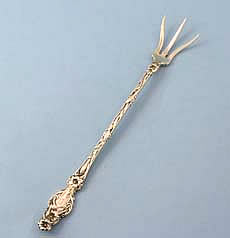
Lily by Frank Whiting

An Art Nouveau pattern, Lily was first introduced by Whiting in 1935. The design of the handle consists of tall leaves gracefully coming up the stem to the terminal (the end of the handle) where an open lily blossom sits in high relief. Then more leaves decorate the sides of the terminal with two more blossoms sitting atop. It is said to be the most sought after pattern by Whiting, which has since been bought by Gorham.


(Fork 7 1/4 inches)

(Master Butter Knife 7 inches)


(Berry Spoon 9 inches)

Berry Spoon


(Lettuce Fork 8 3/4 inches)


Cold Meat Fork (7 5/8 inches)


Jelly Cake Serve (9 inches)

Jelly Cake Server

Fried Oyster Server (8 1/4 inches)


Wednesday, August 11, 2010

Tiffany, the pattern

In 1869 The Tiffany Company introduced its first sterling silver flatware pattern, and appropriately named it "Tiffany". It was designed by Edward C. Moore and described by Osteberg as 'basically a modified Greek double-scroll surmounted by a shell like antefix'. Rising from the stem were small honeysuckle blossoms which flared outward. The pattern was reintroduced in in 1956 as Beekman.


Salad Fork (7 inches)


Salad Serving Set (10 inches)

Salad Serving Set

Buckwheat Server (9 1/4 inches)

Buckwheat Server

Ice Tong

Ice Tong

Waffle Server

Waffle Server


Monday, August 9, 2010

Raphael by Alvin

This glorious art nouveau pattern was introduced by Alvin in 1902. Alvin is now a sub-division of Gorham. (But do not confuse this pattern with Gorham's Raphael pattern, which is a totally different pattern.)

Alvin's Raphael is described as a lady draped in sheer cloth. Her long hair flows around her down the piece of silver. Different floral designs including orchids, iris, and other flowers make each piece a little unique. For example, on the tongs she is standing under a daffodil with orchids on the pinchers.


Sugar Spoon (6 inches)


Orange Spoon (5 7/8 inches)

Orange Spoon


Tomato Server (8 1/4 inches)

Tomato Server, Solid Piece


Oyster Fork (5 5/8 inches)

Oyster Fork

Small Cucumber Server (6 3/8 inches)

Small Cucumber-Tomato Server With Tee


Small Cold Meat Serving Fork (7 3/4 inches)

Large Solid Cold Meat Serving Fork

Gravy Ladle (7 1/2 inches)
Gravy Ladle

Preserve Spoon (7 3/8 inches)
Preserve Spoon


Friday, August 6, 2010

Stieff Rose by Stieff

Stieff Rose debuted in 1892, the first year Charles Stieff established his silver factory in Baltimore. Stieff Rose is very similar to a pattern made by then-rival Kirk, known as Repousse (which was introduced in 1828). Though very similar in design, the two patterns are different.The two companies merged in 1979, and the company is now known as Kirk Stieff.

Stieff Rose by Stieff (1892)

Repousse by Kirk (1828)


Dinner Fork (7 1/4 inches)


Regular Fork (6 7/8 inches)


Berry Spoon (8 1/8 inches)

Berry Spoon

Ice Cream Spoon (6 1/8 inches)

Ice Cream Spoon

Roast Beef Serving Fork (7 inches)


Salad Fork (6 inches)


Wednesday, August 4, 2010

Mayflower by Kirk

There are ten different "Mayflower" patterns by ten different silver companies. Kirk introduced their Mayflower pattern in 1846. Their 1938 catalog stated "The Kirk Mayflower is a beautiful hand engraved design, inspired to Kirk about 90 years ago by an original piece brought over in the "Mayflower" for which the pattern is named. It has been the choice of four or five generations of prominent families and is continually increasing in favor."

208 Piece S. Kirk & Sons Flatware Set, 'Mayflower' Pattern

(Fork 7 1/4 inches)


(Iced Tea Spoon 7 5/8 inches)


(Teaspoon )

Teaspoon


(Hollow Butter Spreader)

Modern Hollow Butter Spreader (stainl


Monday, August 2, 2010

Old Masters by Gorham

Most people don't realize but the original "Old Master" pattern was Gorham Old Masters in which different pieces depicted one of the Old Master Artists. The pattern was introduced in 1885 by Gorham. It was designed by Antoine Heller, a French born designer who first worked for Tiffany before Gorham hired him away to work for them.

This is a very unique pattern. Each piece is three dimensional, ornate, and heavy on details. Some of the artists on these pieces I was unable to identify.


Coffee Spoon 5 inches (Lorraine)

Coffee Spoon

Fish Fork 8 3/4 inches (Rembrandt)
Large Solid Fish Serving Fork in the Old Masters (sterling, 1885) pattern by Gorham Silver


Table Serving Spoon 8 3/8 inches (Reubens)

Tablespoon (serving Spoon)


Large Solid Pie Knife (Van Dyck)

Large Solid Pie Knife

Cream Ladle 5 5/8 inches (Peter Fischer)
(German Sculptor Peter Fischer 1455-1529)

Cream Ladle, Solid Piece

Small Soup Ladle 11 1/2 inches (Tizian)

Small Solid Soup Ladle

Salad Serving Fork 10 inches (Raphael)

Salad Serving Fork

Sauce Ladle 5 3/4 inches (Vischer)

Sauce Ladle

Desert/Tea Knife

Dessert/tea Knife, Solid Piece


Fork 7 1/2 inches (CORREGGIO)

Fork in the Old Masters (sterling, 1885) pattern by Gorham Silver

Teaspoon 5 3/4inches (VELAQUEZ)
(Spanish painter Diego Velazquez 1599-1660)

Teaspoon in the Old Masters (sterling, 1885) pattern by Gorham Silver

Small Berry Spoon 8 1/2 inches (Rembrandt)

Small Solid Berry/casserole Spoon in the Old Masters (sterling, 1885) pattern by Gorham Silver

Sugar Spoon 6 inches (VELASQUEZ)

Sugar Spoon in the Old Masters (sterling, 1885) pattern by Gorham Silver


Flat Handle Master Butter Knife 7 3/4 (van Dyck)
(Flemish painter Anthony van Dyck 1599-1641)

Flat Handle Master Butter Knife in the Old Masters (sterling, 1885) pattern by Gorham Silver


Friday, July 30, 2010

Croquette Servers

This is a rare but practical piece - a Croquette Server. In the Northeastern United States, Croquettes were used as a way to serve leftover ham. But in the South, typical Croquettes were Salmon Croquettes. I could find very few examples of this utensil, and the ones I found were from extremely old patterns. These three patterns all date back to the 1800's. Later on, one would see the term "Croquette server" lumped under the description of the Tomato Server or the Asparagus Server (non-hooded). No longer was it a unique utensil. It's duty merely assigned elsewhere.


Shown in Medallion by Gorham (8 3/4 inches)


Shown in New Queens by Durgin (6 5/8 inches)
Small Pierced Solid Croquette Server

Shown in Ivy by Gorham (9 3/8 inches)
Large Solid Croquette Server