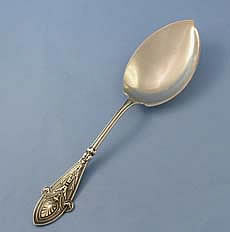
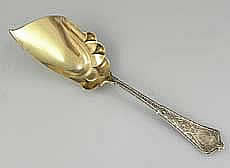
Being from the South, Silver is a very big part of my life. It doesn't have anything to do with wealth. Although those with more money - old money, tend to have more of it. New money tend not to spend their money on Silver. They do not have the appreciation for the warmth of the metal, the beauty of the patina, the story it tells of the generations past who have used it. A true southern girl comes of age when she chooses her silver pattern, long before she chooses her mate. If she is smart, she chooses that of her mother, grandmother, or favorite great aunt who in their benevolence will pass their silver on to her. It is the pieces in those sets, the pieces on our tables, along with the pieces we find in the corners of the displays in antique stores that prompted me to start this blog. They are beautiful, they are odd, but what are they, and what in the hell do you do with them?
Rondo, Du Barry, , Silver Masterpiece, Candlelight, Stieff Rose by Kirk Stieff (5 1/2 inches) Cactus by Georg Jensen (4 3/8 inches) Scroll by Georg Jensen ( 4 3/8 inches) Pompador by Birks (5 1/8 inches)
Durgin introduced its beautiful Scroll pattern in 1886. The design that ascends in size from the terminal to the end of the stem, is more an elaborate display of leaves and flowers Teaspoon (5 3/4 inches) Fork (7 1/4 inches) Long Handle Oyster Fork (7 inches)
Often referred to as a Fish Knife as I mentioned in an earlier post, the Fish Server is designed to work with the Fish Fork to gently serve the delicate meat of the fish without breaking it up.
Much like the regular Oyster Fork, these are examples of the Long Handle Oyster Fork. They are not found in many patterns, in fact just a few manufacturers include them in their patterns.
Durgin produced some beautiful sterling pieces and I kept coming across lovely Berry/Casserole Spoons, so I thought I would share a few from some Durgin patterns.