The Story Behind this Blog

Being from the South, Silver is a very big part of my life. It doesn't have anything to do with wealth. Although those with more money - old money, tend to have more of it. New money tend not to spend their money on Silver. They do not have the appreciation for the warmth of the metal, the beauty of the patina, the story it tells of the generations past who have used it. A true southern girl comes of age when she chooses her silver pattern, long before she chooses her mate. If she is smart, she chooses that of her mother, grandmother, or favorite great aunt who in their benevolence will pass their silver on to her. It is the pieces in those sets, the pieces on our tables, along with the pieces we find in the corners of the displays in antique stores that prompted me to start this blog. They are beautiful, they are odd, but what are they, and what in the hell do you do with them?

Wednesday, September 1, 2010

More Oyster Forks

I posted about Oyster forks earlier, but here are even more lovely examples of Oyster Forks as individual place pieces.


Shown in Cupid by Shiebler (6 1/8 inches)


Shown in English King by Tiffany


Shown in Laura by Buccellati (5 5/8 inches)


Shown in Marechal Niel by Durgin (5 3/8 inches)


Shown in Saratoga by Tiffany (5 inches)


Monday, August 30, 2010

Magnolia by Durgin

Introduced in 1898 by Durgin, Magnolia is an absolutely gorgeous pattern with a magnolia blossom on the top of the handle. 


Bouillon Soup Spoon (5 1/2 inches)


Salad Fork (6 inches)


Salad Fork


Youth Tea Fork (6 1/8 inches)
Solid Youth Tea Fork

Friday, August 27, 2010

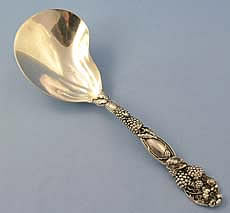
Blackberry by Tiffany

Introduced by Tiffany in 1875, the pattern Blackberry is often linked with its sister pattern Strawberry  and linked with the "Vine" patterns designed by Tiffany. It is in fact not a part of the "Vine" pattern family and, though, similar, is a separate pattern from Strawberry. Where Strawberry's stem is an open woven vine, Blackberry's stem is solid and decorated with the leave and berries of the fruit. The motif pattern through out the pattern is the leaves, berries, vine, and flower of the fruit.


3 Tine Fruit Fork (6 inches)


Fruit Serving Spoon (9 1/2 inches)


Wednesday, August 25, 2010

St James by Tiffany

A Renaissance Revival style designed by Paulding Farnham for Tiffany in 1898 that became inactive in 1912.  One of the first features one notices in St. James is the crossed multi-ribbed bands. This gives an open area for engraving. A line of beading goes down the handle.The design on the back is very simliar to the compex pattern of the front.  According to William Hood's book  Tiffany Silver Flatware "The significance of the name 'St. James' is unclear."


(Fruit Orange Spoon)

Fruit/orange Spoon

(Lobster Pick)

Lobster Pick


(Preserve Spoon)

Preserve Spoon

(Small Steak Carving Fork)

Small Steak Carving Fork With Stainle


(Sardine Fork)

Small Solid Tined Sardine Serving For


(Asparagus Tongs)

Asparagus Tongs, Solid Piece


(Salad Serving Fork)

Salad Serving Fork, Solid Piece


(Serving Spoon 9 3/8 inches)

Monday, August 23, 2010

New Art by Durgin

This very rare American Art Nouveau pattern, New Art was introduced by Durgin in 1898. I absolutely love Durgin designs for their detail and to me this is the best example of their fine craftsmanship. The detail is deep and complex, with different floral themes of Irises, Lilies, and Daffodils.


Cold Meat Fork (with Iris) (9 1/2 inches)
Cold Meat Fork


Asparagus Fork (10 1/8 inches)
Asparagus Fork


Beef Fork (with Daffodils) (5 3/8 inches)
Beef Fork


Berry Spoon (with Lilies) (8 3/4 inches)


Ice spoon (8 3/4 inches)
Ice Spoon


Pie Knife (with Lilies 10 1/8 inches)
Pie Knife


Small Chipped Beef Fork (with Narcissus) ( 6 3/8 inches)
Small Chipped Beef Fork


Cream Ladle (with Narcissus) (6 inches)
Cream Ladle, Solid Piece


Salad Serving Fork ( with Iris) (9 3/8 inches)
Salad Serving Fork, Solid Piece


Pattern detail of Durgin ‘New Art’ Pattern Sterling Silver Waffle Server or Cake Lifter, c. 1900


Friday, August 20, 2010

Lap Over Edge by Tiffany (Mixed Metals)

This pattern by Tiffany is offered in different forms. This particular design is "mixed metals". Lap Over Edge is one of Tiffany's most detailed and complex patterns. The motiffs are three dimensional and of natural designs, representing flora and fauna. This is one of their Japanese patterns. The details and enhancements are true art. These pieces are now valued by collectors with some individual pieces costing as much as $7k.


The pattern was designed by Charles Grosjean and introduced in 1880. It became inactive in 1904. 

Teaspoon (with gold ivy leaves with berries) (6 inches)


Teaspoon

Salad Serving Fork (with gold turtle)

Salad Serving Fork

Coffee Spoon (crab) (4 3/4 inches)
Coffee Spoon

Coffee Spoon (with vine and grapes) (4 3/4 inches)

Coffee Spoon

Mint Julep Spoon (or Muddler) (with grasshopper) (6 inches)
Mint Julep Spoon

Wednesday, August 18, 2010

Bug by Durgin

This pattern was introduced by Durgin in 1885.  A truly unique pattern with a motif of different bugs on the handle, including bees, beetles, and lady bugs. A whimsical idea, however many diners may have not found the snake wrapped around the stem of each piece appetizing.


Soup spoon -  (5  3/4  inches)
bug1.JPG


bug2.JPG


Solid Berry Serving Scoop 
Solid Berry Serving Scoop


Salad Fork (6  5/8 inches)


Monday, August 16, 2010

A Rose by any Other Name (Part 2)

And, there are yet more sterling patterns named Rose. It is interesting to me the differences - from the very elaborate (Bridal Rose) to the simple (Castle Rose). Short of the name, and possibly a floral motif, they sometimes have little in common, with the exception of being made of sterling silver and designed as an utensil for dining.


Castle Rose by Royal Crest (no date) (Designed by Grosvenor N. Allen & Lloyd E. Ressegger)


Bridal Rose by Alvin 1903


Baltimore Rose by Schofield 1905


Windsor Rose by Watson 1940 (Designed by William T. Brown)


Wild Rose by Watson 1900 (Designed by Eustace Crees and Charles S. Court)


Wedding Rose by Watson 1900 (Designed by Joseph E. Straker, Jr.)


Dorian Rose by Watson 1937 (Designed by Percy B. Ball)


English Rose by Durgin 1955 (Designed by William C. Codman) (The same pattern issued in 1899 as Cambridge by Gorham)


Hand Chased Rose by Schofield 1906


Jac Rose by Gorham 1885


Milburn Rose by Westmorland 1940