The Story Behind this Blog

Being from the South, Silver is a very big part of my life. It doesn't have anything to do with wealth. Although those with more money - old money, tend to have more of it. New money tend not to spend their money on Silver. They do not have the appreciation for the warmth of the metal, the beauty of the patina, the story it tells of the generations past who have used it. A true southern girl comes of age when she chooses her silver pattern, long before she chooses her mate. If she is smart, she chooses that of her mother, grandmother, or favorite great aunt who in their benevolence will pass their silver on to her. It is the pieces in those sets, the pieces on our tables, along with the pieces we find in the corners of the displays in antique stores that prompted me to start this blog. They are beautiful, they are odd, but what are they, and what in the hell do you do with them?

Saturday, December 12, 2009

Crumb Knife

Not just for the efficient waiter in the fancy restaurant, these are available in your pattern for use at your dining room table. The Crumb Knife (or Crumber) is designed to remove crumbs from your table. My assumption is that this was not meant for the lady of the house but more likely for her house servants.

This can be a very expensive piece in some of the older patterns.

(Unknown pattern by Duhme)

Wednesday, December 9, 2009

Oyster Servers

Yes, there are two - the Oyster Server and the Fried Oyster Server, as well as an Oyster Fork, which is used in addition to a five piece place setting. The server is used to serve oysters both in and out of the shell, while the fried server, just like its name, is used to serve fried oysters. (And, to think all these years I have been using a standard serving spoon - how embarrassing.)

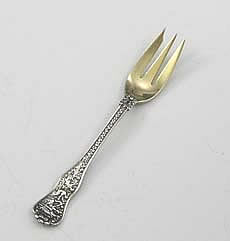
The Oyster Server shown Lancaster by Gorham


Oyster Fork shown in Olympian by Tiffany

Tuesday, December 8, 2009

Petite Four Server

If you didn't know before, you need the Petite Four Server to properly to serve your petite fours. You can find this piece in most patterns.


(Shown Love Disarmed by Reed and Barton)

Monday, December 7, 2009

Jelly/Cake Server

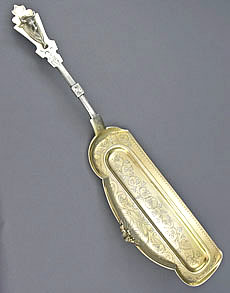
Once again, not to be confused with your every day cake server, the Jelly/Cake Server looks like a cake server or pie server and can be used to lift and serve pie or cake, however this piece can also properly serve solid jellies. It would have taken a while for someone just to have learned which of these pieces were used for which occasion. God forbid one use a regular cake server when the occasion called for a Jelly/Cake Server.

(Shown in Stratford by International)

Jelly/cake Server in the Stratford (sterling, 1902, No Monograms) pattern by International Silver

Sunday, December 6, 2009

Cracker Spoon

The every day Cracker Spoon, used to scoop and serve crackers. I think most likely oyster and soup crackers (I don't think saltines would fit well in the scoop.) There is a pierced and solid. Here are examples of both.

Old English by Towle (7 1/2 inches)

Click to Enlarge


Click to Enlarge

Ice Cream Slicer

Don't confuse this with an ice cream knife, the Ice Cream Slicer is different. There was a time when ice cream was made like large blocks of ice and very hard. This utensil was used to slice the ice cream from these blocks into pieces that would fit nicely into serving dishes and on plates.

(Shown in Old Master by Towle)


Saturday, December 5, 2009

Cake Saw

Now not to be confused with the cake knife or the wedding cake knife, the Cake Saw has a serrated side with long teeth. I never could find a reason one would need "long teeth" to cut a cake unless it was Aunt Maude's ungodly fruit cake that was more like a brick and everyone avoided it on the family buffet.(10 1/2 inches)


Lily of the Valley by Whiting (10 inches)
Click to Enlarge

Friday, December 4, 2009

Sardine Fork

Given that I have never served my guests sardines, I'm not sure I would have a use for a Sardine Fork, although I must admit it is an attractive piece. After some diligent searching I found a description of the need and use of this rather odd piece, and I quote, "The distribution of canned food forever changed cuisine in the U.S. The Midwest, for example, never received seafood until it got a shelf-life. Canned sardines were a huge hit in non-coastal areas and their novelty warranted a new utensil. Seven short tines were just right for stabbing the length of this long but little fish out of its oil." Further research shows perhaps they are more practical and for things other than sardines. They can be used for serving pickled vegetables, anchovies, and petits fours - now there's a variety for you.

Unlike most pieces that are simliar across sterling companies and patterns, this particular piece was all over the map. I found one by International with 6 tines, another with only 5 tines. Old master by Towle had a Sardine Server that was flat with no tines as did Grande Baroque- Continental by Wallace.
(Shown in Orange Blossom by Old Alvin 5 3/8 inches)


Thursday, December 3, 2009

Corn Butterer

Oddly enough, I could not find a description of a sterling Corn Butterer and never having had one at my plate when served corn, I had no personal experience. However after looking at it, I assume that one would put butter in it and then use it to rub on an ear of corn. Actually, it could come in as a handy piece, expensive, but handy.

(Shown here in Francis I by Reed and  Barton)

Wednesday, December 2, 2009

Bonbon Spoon

Now the Bonbon Spoon may be a more familiar piece to some of us. However, were you aware that there are three types? - a Bonbon Scoop, a Bonbon Pierced Spoon, & the more popularBonbon Solid Spoon. The difference between the "scoop" and the "spoon" is that the "scoop" has a shell bowl, while the "spoon" has a rounded one. To complicate life, you can also have a Bonbon Nut Server and Bonbon Tongs. I think they carry this to the extreme but then the Victorian era did love their candies. And, for those curious sorts, Bonbons are candies rolled into balls usually made of chocolate. These silver pieces were designed to keep the chocolates from melting in their hands since they had no air conditioning (and M and Ms had yet to be invented)

(The pierced spoon shown is Buttercup by Gorham 4 5/8 inches)

Click to Enlarge

(The Solid Spoon shown in Repousse by Kirk  5 1/8 inches)

Click to Enlarge

(The Scoop shown in Landers No.2 by Baker Manchester 5 3/8 inches)

Click to Enlarge