Being from the South, Silver is a very big part of my life. It doesn't have anything to do with wealth. Although those with more money - old money, tend to have more of it. New money tend not to spend their money on Silver. They do not have the appreciation for the warmth of the metal, the beauty of the patina, the story it tells of the generations past who have used it. A true southern girl comes of age when she chooses her silver pattern, long before she chooses her mate. If she is smart, she chooses that of her mother, grandmother, or favorite great aunt who in their benevolence will pass their silver on to her. It is the pieces in those sets, the pieces on our tables, along with the pieces we find in the corners of the displays in antique stores that prompted me to start this blog. They are beautiful, they are odd, but what are they, and what in the hell do you do with them?
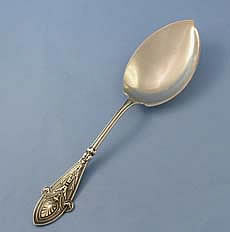
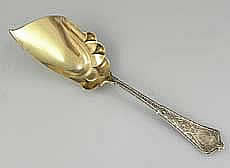
Every once in a while you run across some pieces that get classified in very general terms such as "forks", here are some elegant serving pieces classified as "Servers".
"Elephant Ear" Server (in Olympian pattern by Tiffany) (10 3/4 inches)
Sterling Silver Shovel (in Lady pattern by Gorham) (10 inches)
A simple pattern, but elegant in its simplicity. Morning Glory was introduced by Alvin in 1909. The pattern has an open Morning Glory blossom on the terminal and another at the top of the stem with an area between suitable for engraving. Thin lines run down the stem to a small leaf and a third very small blossom at the bottom of the stem just before the shoulder. The design is detailed and deep.
Not a particularly old pattern, Milburn Rose was introduced by Westmorland in 1940. The only decoration is the flat rectangular terminal that sports a rose motif surrounded by leaf embellishments.
Introduced in 1899 by Alvin, Edward II is a very strong, almost masculine pattern. The terminal has a knight's helmet and what looks like either a shield or coat of arms. The shoulder of the spoons is decorated with elegant flourishes that follow around the edge of the bowl.
I posted earlier about the Almond Scoop, a beautiful piece, very similar to the design of the pierced Bonbon Scoop. Canterbury by Towle (4 3/4 inches) Georgian by Towle (4 1/2 inches) Wellington by Alvin (4 1/2 inches) Old English by Towle (4 3/8 inches)
Often referred to as a Fish Knife as I mentioned in an earlier post, the Fish Server is designed to work with the Fish Fork to gently serve the delicate meat of the fish without breaking it up.
First introduced in 1892, Apollo is a refined pattern with a beaded stem topped by a floral motif at the bottom of the terminal which is surrounded by decorative work. I'm not sure where the inspiration for name came from, but a pretty pattern none the less.
I have posted on these several times before but I find they are such neat utensils and reflect the beauty of the patterns. Here are some more examples of the Oyster Fork.
I posted earlier on Grapefruit spoons. These are usually easily recognized because of their pointed bowls (to pierce the pulp of the fruit). On some of the more elaborate patterns, the design will be carried to edges of the bowl.